

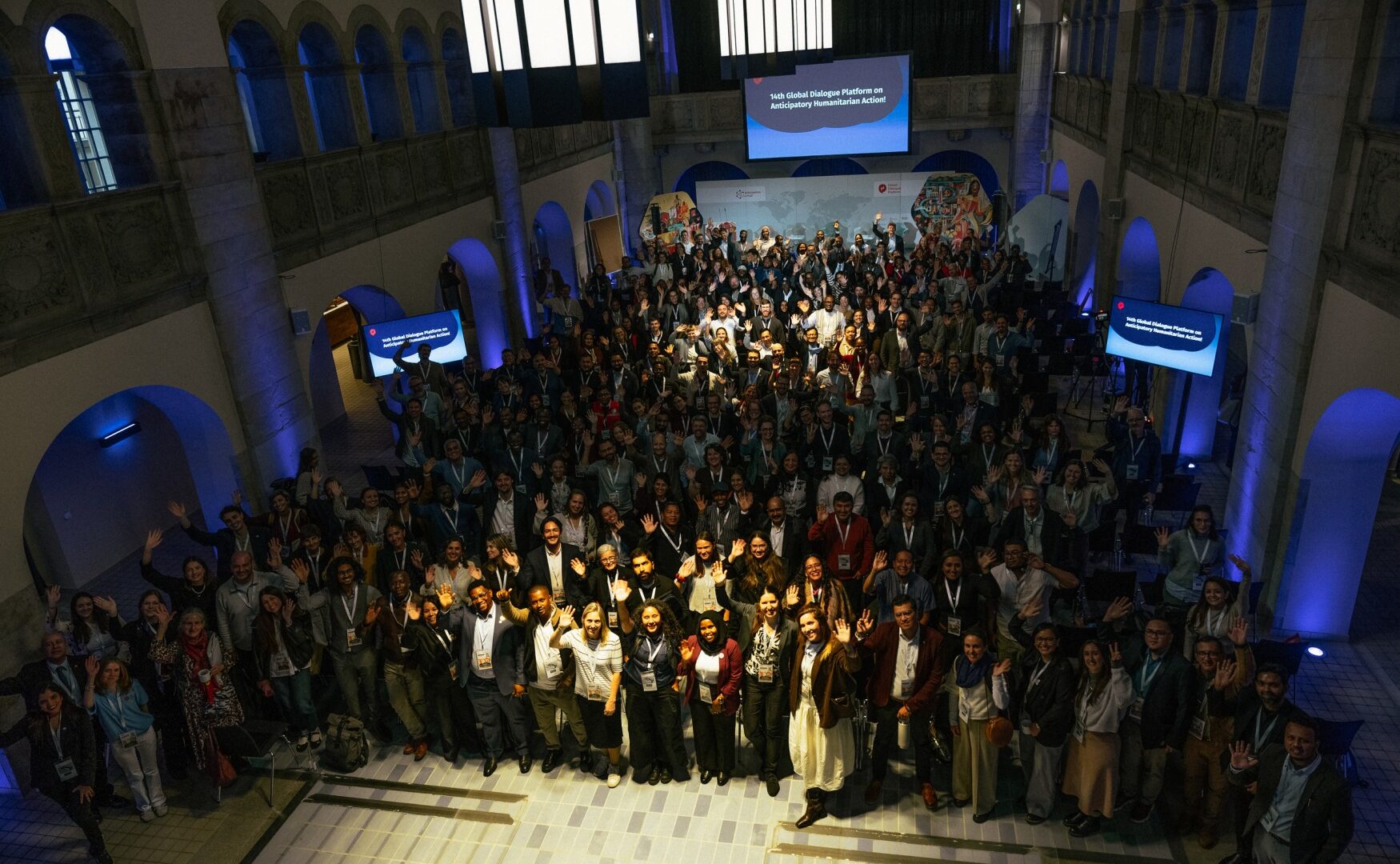
In the face of hurricanes, anticipatory action enables humanitarian actors to prepare and respond before a disaster strikes. In the Caribbean, three National Red Cross Societies have joined forces to pool their experience and develop their own Early Action Protocols. This regional cooperation initiative was presented on 22 October 2026 in Berlin, at the Global Dialogue Platform on Anticipatory Action.
For its 14th edition, the Global Dialogue Platform (GDP) brought together stakeholders involved in advancing anticipatory action, both in Berlin and online, under the theme “Connecting efforts, strengthening systems, enabling scale: financing the future of anticipatory action”. This approach aims to deliver humanitarian assistance before a hazard has an impact, based on forecasts and predefined trigger thresholds.
Mathilde Duchemin, Disaster Risk Management and Crisis Management (DRM) Technical Officer, represented the French Red Cross at the event. The previous day, she had also taken part in Red Cross Red Crescent Day, held at the headquarters of the German Red Cross. The event provided an opportunity to present the International Federation’s new generation of Early Action Protocols (EAP 2.0), designed to make this methodology more accessible to smaller National Societies. The German Red Cross also presented its new anticipatory action handbook.
Three Caribbean countries join forces to prepare for hurricanes

On 22 October, during the session “Anticipatory action for cyclones: Operational lessons and collective learning”, Cheslin Maloney, Early Action Protocol Focal Point at the Saint Kitts and Nevis Red Cross Society, presented a joint initiative involving the National Red Cross Societies of Antigua and Barbuda, Dominica, and Saint Kitts and Nevis.
The starting point was a shared reality: hurricanes do not stop at national borders, while smaller National Societies often have to operate with limited teams and resources. Rather than developing their protocols separately, the three Societies chose to work together to develop three simplified Early Action Protocols (sEAPs), each tailored to its national context.
These are the first protocols of this kind to be jointly developed for Small Island Developing States. Their development was made possible through funding from the French Development Agency (AFD), under the 3 Oceans Programme, with this activity led by PIRAC. The process also benefited from the technical support of 510, the digital team of the Netherlands Red Cross, as well as support from the European Union through the PARATUS project and from the International Federation of Red Cross and Red Crescent Societies (IFRC).
Three lessons for advancing anticipatory action
Beyond the methodology itself, this experience generated three operational lessons, which were shared with participants at the platform:
-
Share what can be shared, adapt what needs to be adapted. The three countries have several things in common, including their use of forecasts from the National Hurricane Center, the definition of trigger thresholds and certain anticipatory actions, such as distributing hygiene kits, preparing shelters and supporting vulnerable households. However, their levels of exposure, capacities and governance arrangements differ. Dominica, for example, is particularly exposed to floods and landslides. The idea of developing a single sub-regional protocol was therefore set aside: a hurricane may strike one island while leaving the others unaffected.
-
Test the plan, not just write it. A simulation exercise held in Guadeloupe in August 2026 helped identify activities that would be impossible to carry out within the available lead time. One key lesson emerged: a humanitarian action that is relevant after a disaster is not necessarily suitable for anticipatory action if it cannot be implemented before the impact.
-
Make peer-to-peer learning a result in its own right. Solutions developed by one National Society informed the work of the other two. This exchange of knowledge helped pool experience, address shared challenges and reduce the workload for each team.
This approach also highlights the importance of establishing coordination mechanisms in advance, at technical, operational and institutional levels. The aim is to prepare decision-making and collaboration processes ahead of time, in order to “remove as many decisions as possible from the emergency itself”.
This Caribbean experience reflects one of the key challenges raised at the Global Dialogue Platform: harmonising tools to support their wider implementation without losing sight of local realities. Several contributions also emphasised the need to establish coordination mechanisms well before a disaster strikes. In Mozambique, for example, the World Food Programme (WFP) highlighted that, in the case of cyclones, there may be as little as three to four days between a trigger threshold being reached and the storm making landfall. Within such a short timeframe, only coordination arrangements established in advance can turn forecasts into concrete action.
Learn more about the technical and coordination challenges involved in this joint process.