

Anticipating in the heart of the Caribbean
As climate hazards intensify, anticipation is no longer optional – it is a key lever for saving lives and reducing human and economic losses. By 2030, climate-related losses and damages could reach between $290 and $580 billion per year, while early warning systems and anticipatory action can reduce impacts by up to 30%. Yet nearly half of the world’s population still lacks access to these systems.
It is within this context that our commitment to Anticipatory Action takes shape, through the development of a sub-regional Early Action Protocol (EAP). In partnership with the Netherlands Red Cross – 510 team, we coordinate and support the Red Cross Societies of Antigua and Barbuda, Saint Kitts and Nevis, and Dominica in designing and implementing this protocol. Rather than working in isolation, these three countries have chosen an innovative sub-regional approach, built on the sharing of tools, expertise, and efforts.
What is an Early Action Protocol ?
An Early Action Protocol is a tool that enables the activation of the International Federation of Red Cross and Red Crescent Societies’ Disaster Relief Emergency Fund ahead of disasters.
An EAP allows humanitarian funding and actions to be automatically triggered before an extreme weather event occurs.
In practical terms, it is based on three pillars:
- Clearly identified risks (e.g. hurricanes, tropical storms)
- Pre-defined trigger thresholds, based on reliable scientific and meteorological forecasts
- Pre-planned early actions, ready to be implemented as soon as thresholds are reached
The goal is to gain critical hours, sometimes even days, to evacuate, protect, inform communities, pre-position assistance, and thereby significantly reduce human, social, and economic impacts.
Our role: leadership, coordination, and expertise
The PIRAC supports the Red Cross Societies of Antigua and Barbuda, Dominica, and Saint Kitts and Nevis in the development of this protocol, in close partnership with:
- The Netherlands Red Cross – Team 510 (Data & Digital),
- National disaster management agencies,
- National meteorological services,
- The International Federation of Red Cross and Red Crescent Societies (IFRC).
Our added value lies in:
- Steering complex, multi-stakeholder projects,
- Regional coordination between technical and humanitarian institutions,
- Translating scientific data into operational decision-making,
- Facilitating dialogue spaces and co-construction processes.
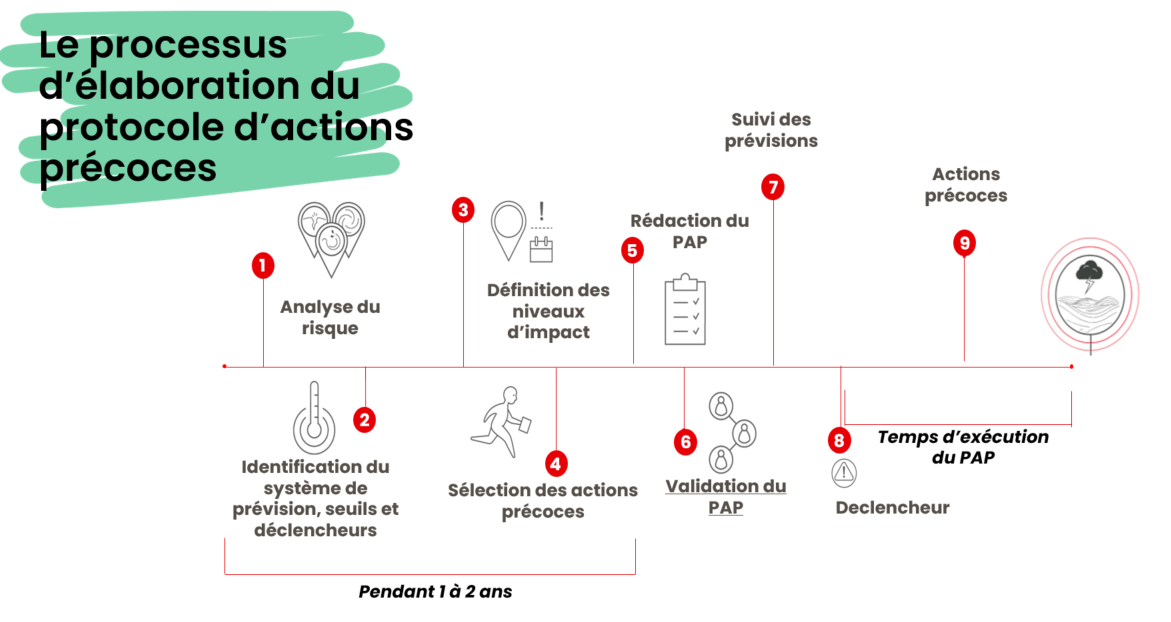
Processus d’élaboration du Protocole d’Actions Précoces
Behind the scenes of anticipation
PIRAC and Team 510, the data and digital unit of the Netherlands Red Cross, conducted an in-depth feasibility study exploring the potential for a sub-regional Early Action Protocol for tropical storms and hurricanes in the Eastern Caribbean.
This regional approach is being carried out within the framework of the 3 Oceans programme funded by the AFD – French Development Agency, the European Union’s Horizon Europe programme under the PARATUS project, and with support from the CMA-CGM Fondation.