

How can you prepare for a hurricane ?
What should you do when it strikes ?
build the right reflexes !
What if you were the first link in the resilience chain ?
Definition
A hurricane is a spiraling mass of clouds that forms over the ocean. It develops above the warm waters of the Atlantic and then moves toward the Caribbean. After a few days, an eye may appear at the center of the clouds. The cyclone is then fully formed. Violent winds rotate around the eye in a counterclockwise direction.
characteristics
Wind gusts than can exceed 250 km/h, heavy rainfall that may cause flooding and landslides, thunderstorm activity, and powerful swells that can lead to coastal flooding.
In the Caribbean region, the hurricane season runs from June to November. Stay alert, this does not mean that cyclones cannot form outside this period !
Remember: hurricanes can form outside the hurricane season !
Classification Of tropical cyclones
Tropical depression (sustained winds of under 63 km/h – 38 mph)
Tropical storm (sustained winds of 63 to 118 km/h – 39 to 73 mph)
Category 1 hurricane (sustained winds of 119 to 153 km/h – 74 to 95 mph)
Category 2 hurricane (sustained winds of 154 to 177 km/h – 96 to 110 mph)
Category 3 hurricane (sustained winds of 178 to 208 km/h – 111 to 129 mph)
Category 4 hurricane (sustained winds of 209 to 251 km/h – 130 to 156 mph)
Category 5 hurricane (sustained winds of 252 km/h or more – 157 mph or more)
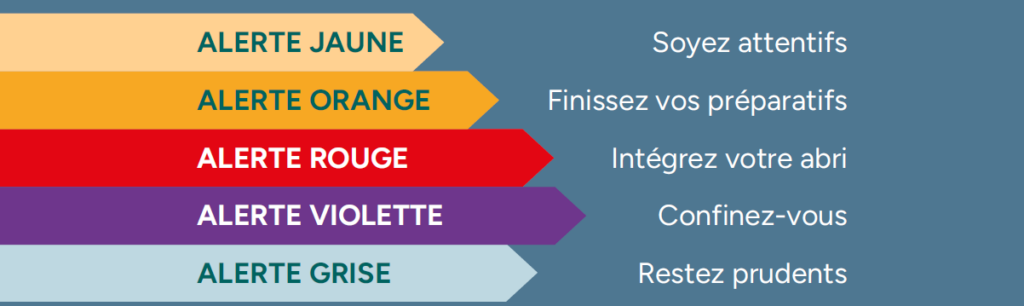
alert levels
examples
Hurricane Maria (category 5, sustained winds : 280 km/h – 174 mph) and Irma (category 3, sustained winds 178 to 208 km/h – 111 to 129 mph) (2017)
Tropical Storm Fiona (sustained winds : around 95 km/h – 59 mph, before later strengthening into a hurricane) (2022)
Hurricane Beryl (category 5, sustained winds : 270 to 280 km/h – 168 to 174 mph) (2024)
what to do
before
➕ Follow official weather advisories and alerts
➕ Check whether your home can withstand wind and water, and make sure it is not in a flood-prone or landslide-risk area
➕ Prepare a shelter plan for all members of your family
➕ Stock up on drinking water and food
➕ Turn off gas, electricity, and water if recommended
➕ Fill up your car’s fuel tank
how to secure your home ?
➕ Reinforce the roof and windows
➕ Prepare your yard by trimming weak or dead tree branches
➕ Store away or secure anything outdoors that could be blown away (garden furniture, tools, toys)
➕ Clean gutters and downspouts, and check the condition of drainage ditches
what to do
during
➕ Stay sheltered : remain in the strongest room without windows, or keep away from windows and glass doors
➕ Do not go outside under any circumstances
➕ Keep your phone charged, but avoid making calls so as not to block emergency lines, use it only in an emergency
➕ Unplug unnecessary electrical appliances to prevent power surges
➕ If the power goes out, use flashlights or battery-powered lanterns for lighting. Do not use candles due to risk of fire
➕ Flooding likely ? Move to a higher floor
what to do
after
➕ Stay cautious : dangers may persist after the alert ends, and the hurricane can also change direction or return
➕ Do not go outside immediately : wait for official authorization before leaving your shelter or home
➕ If someone is injured, call emergency services and provide first aid if you are trained
➕ Avoid overloading emergency lines except in serious situations
➕ Assess damage (wall, roof, foundations) and secure what you can without putting yourself at risk
➕ Stay away from downed power lines and from objects overhead that could fall
➕ Do not drink tap water until authorities confirm it is safe to drink
➕ Throw away any spoiled or thawed food
➕ Support your community : check on loved ones, neighbours, and elderly or isolated people
How to get early warning before a disaster strikes
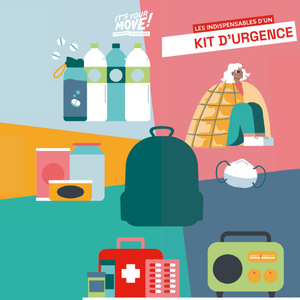
Prepare your 3 days emergency kit

A regional and collaborative initiative
“The Ready 360° Project” – Phase 2 is co-funded by the INTERREG Caribbean Programme through the European Regional Development Fund (ERDF), with support from the French Development Agency – AFD.
This programme brings together numerous operational partners as well as our institutional partners: CDEMA and OECS, along with National Red Cross Societies across the region.
A dynamic 16 month campaign.
Duration : from June 2025 to October 2026